

 Abroadin
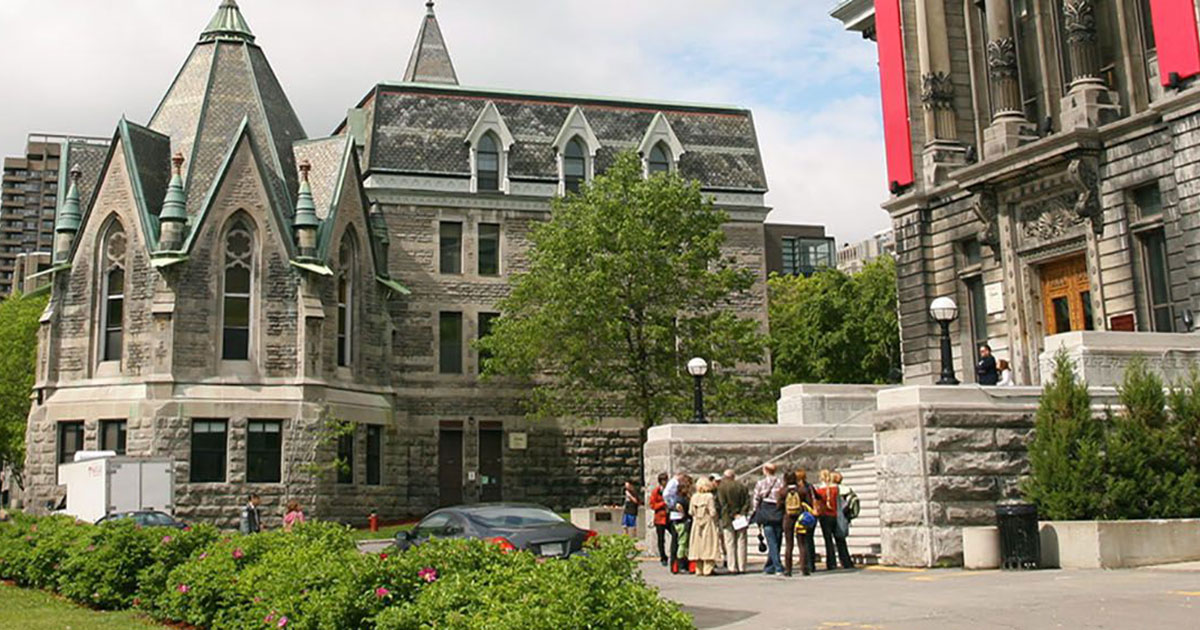
McGill university is a public research university in Québec, Canada. It is one of Canada's best-known institutions of higher education since 1821. Students from more than 150 countries study at McGill. In Fall 2025, McGill had 40,531 students, including 28,167 undergraduate students and 10,196 graduate students. International students accounted for 27% of total enrolment. The university offers more than 300 undergraduate programs and 450 graduate and postdoctoral programs.
All About McGill University
McGill university is a public research university in Montréal, Québec, Canada. McGill traces its origins to 1821, when King George IV granted a Royal Charter establishing McGill College. The institution was named in honor of James McGill, a Scottish-born Montréal merchant whose bequest helped establish the university.
The institution was originally known as McGill College. In 1885, its Board of Governors officially adopted the name McGill university. McGill is one of two Canadian universities that are members of the Association of American Universities (AAU).
Since 2016, McGill has been the only Canadian member of the World Economic Forum’s Global University Leaders Forum (GULF), a group of leaders from some of the world's leading universities.
It has 11 faculties and 14 schools across its campuses. Its academic units cover a wide range of disciplines, including arts, science, engineering, management, medicine and health sciences, education, law, dentistry, music, and agricultural and environmental sciences.
Almost 41 percent of McGill students were born outside of Canada. Over 32 percent of international students come from over 150 countries.
McGill university consistently ranks among the leading universities in Canada and worldwide. According to the latest available rankings:
- No. 1 in Canada among medical-doctoral universities in the Maclean's University Rankings 2027, maintaining this position for more than 20 consecutive years.
- No. 30 worldwide in the QS World University Rankings 2027.
- No. 43 worldwide in the Times Higher Education World University Rankings 2027.
- No. 73 worldwide in the Academic Ranking of World Universities (ShanghaiRanking) 2026.
The McGill University Campuses
McGill university has three campuses, including:
- Downtown Campus: Located in central Montréal, at the foot of Mount Royal. It covers approximately 32 hectares (79 acres).
- Macdonald Campus: Located in Sainte-Anne-de-Bellevue, on the western tip of Montréal Island. It covers approximately 650 hectares (1,606 acres).
- Campus Outaouais: Located in Gatineau, Québec, and primarily associated with French-language medical education offered by McGill's Faculty of Medicine and Health Sciences.
McGill operates the Gault Nature Reserve at Mont-Saint-Hilaire, approximately 40 kilometres from Montréal. This is a separate research and teaching reserve, not a university campus. It protects 1,000 hectares (2,471 acres) of natural environment.
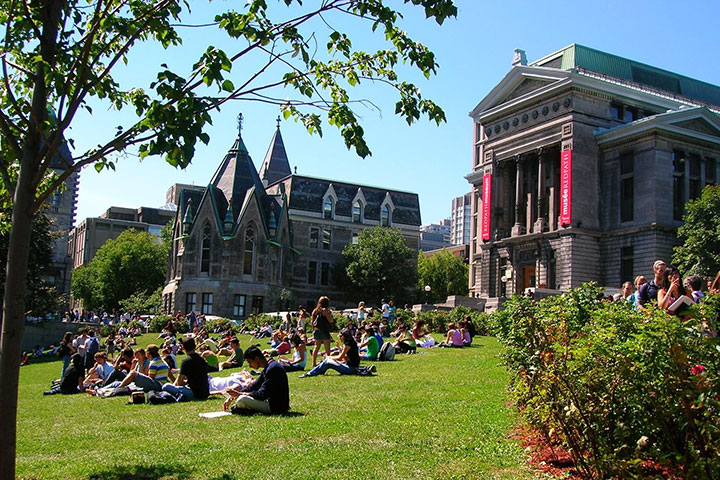
McGill's main Downtown Campus is located at the foot of Mount Royal in central Montréal, Québec.
Macdonald Campus is located approximately 35 kilometres west of McGill's Downtown Campus, in Sainte-Anne-de-Bellevue on the western tip of Montréal Island.
Macdonald Campus is home to McGill's Faculty of Agricultural and Environmental Sciences, the School of Human Nutrition, and the Institute of Parasitology. It also includes agricultural research facilities, greenhouses, and a research farm.
The McGill Faculty and Staff
McGill has a large academic, administrative, and support workforce. According to its published institutional statistics, the university had 1,677 tenured and tenure-stream faculty members. It also reported 4,431 administrative and support staff members as of January 31, 2025.
McGill university offers:
- more than 300 undergraduate programs and
- 450 graduate and postdoctoral programs across more than 80 academic departments.
The alumni include several Nobel Prize recipients, such as Willard Boyle, Val Fitch, David Hubel, Rudolph Marcus, Andrew Schally, Ralph Steinman, Jack Szostak, and John O'Keefe. The university has also produced 149 Rhodes Scholars. Its distinguished alumni include three Canadian prime ministers: Sir John Abbott, Sir Wilfrid Laurier, and Justin Trudeau.
McGill university has a notable place in the history of sports. Its alumnus James Naismith invented basketball, while the university's early students and athletic teams contributed to the development of organized ice hockey and football in Canada.
Ernest Rutherford is one of the most notable scientists associated with McGill university. He worked as a professor of physics at McGill from 1898 to 1907, where he conducted groundbreaking research on radioactivity in collaboration with chemist Frederick Soddy.
Rutherford received the 1908 Nobel Prize in Chemistry for his research on radioactive substances. His later discovery of the atomic nucleus took place after he left McGill.
Researchers and alumni associated with McGill have contributed to several important scientific and technological innovations.
These include Thomas Chang's invention of the world's first artificial cell, Alan Emtage's creation of Archie, widely recognized as the first Internet search engine, and the charge-coupled device (CCD), co-invented by McGill alumnus Willard Boyle and George E. Smith at Bell Labs.
The Educational Quality
McGill university believes its primary goal is to improve learning and knowledge creation and transmission.
They try to do this by delivering good education, conducting research and scholarly activities with high international standards, and providing service to society.
McGill university Library provides major collections, access to the world of information, and exceptional service to support teaching, learning, research, and community service.
McGill has the highest average entrance grades of any Canadian university and provides degrees and certificates in over 300 fields of study.
McGill's Career Planning Service (CaPS) supports students and alumni through career counselling, individual advising, skills-development workshops, experiential learning opportunities, career exploration programs, mentoring, and networking events. It also provides access to job opportunities, internships, and post-graduation employment resources through its myFuture platform.
In keeping with McGill's commitment to education and innovation, Athletics and Recreation commit to providing students and workers with opportunities to participate in sports and physical activity in an inclusive environment that values health, well-being, and fair play.

About the Courses at McGill University
McGill university offers more than 450 graduate and postdoctoral programs across more than 80 departments. Its academic offerings include master's degrees, doctoral degrees, professional programs, diplomas, and graduate certificates.
- Agricultural and Environmental Sciences
- Arts
- Dental Medicine and Oral Health Sciences
- Education
- Engineering
- Law
- Desautels Faculty of Management
- Medicine and Health Sciences
- Science
- Schulich School of Music
- School of Continuing Studies
McGill has more than 300 undergraduate programs and 450 graduate and postdoctoral programs, giving students a wide range of academic and research opportunities. International students can apply for Bachelor's degrees, master's degrees, doctorates, diplomas, and certificates.
McGill provides an official online Course Catalogue where prospective and current students can explore academic programs, course descriptions, degree requirements, academic regulations, and other important information. The current academic cataloge is available for the 2026–2027 academic year.
International students applying to thesis-based master's and PhD programs should review the academic profiles and research interests of faculty members in their chosen department.
Applicants should identify potential supervisors whose research aligns with their interests and contact the relevant department to learn about supervision availability and program-specific application requirements.
McGill University Admission Process
McGill offers admission for different academic terms depending on the level of study and the selected program:
- Undergraduate admission is primarily available for the Fall semester, while
- January (Winter) admission is limited to selected programs and eligible applicant categories.
- Graduate programs may offer Fall, Winter, or Summer admission, depending on departmental availability.
Undergraduate applications for Fall admission open online on October 1. Application deadlines depend on the applicant's educational background, citizenship, and selected program.
For Fall 2027 admission, the application deadline for applicants studying, or who last studied, at a high school, college, or university outside Canada or the US is January 15, 2027. Applicants from other educational backgrounds may have different deadlines and should consult the official admissions calendar.
Undergraduate admission for the January (Winter) semester at McGill is limited. Only selected programs accept applications, and eligibility depends on the applicant's educational background and academic status. The available programs and their application deadlines are published on McGill's official January admission page and are updated each year.
Most graduate programs at McGill use a rolling admissions process, which means applications may be reviewed as they are received and programs may reach capacity before the final deadline.
Unless a specific program establishes an earlier deadline, the general application deadlines for international graduate applicants are:
- Fall semester: January 15
- Winter semester: August 1
- Summer semester: October 1
International applicants should carefully review the application deadlines and document submission requirements for their chosen programs. Some departments have earlier deadlines than the university's general application dates.
Applicants must submit their applications and supporting documents according to the instructions provided in the McGill Applicant Portal or the graduate admissions system. Document requirements and submission deadlines vary by program.
Late applications may not be considered for Canadian scholarships. McGill also reserves the right to cancel an application submitted after the published deadline or transfer it to a subsequent admission term.
Step-by-Step Guide to Applying to McGill University
The application process at McGill university involves several steps. Requirements may differ between undergraduate and graduate programs.
Step 1: Choose a Program
Explore McGill's undergraduate and graduate program catalogues. Select a program that matches your academic background, interests, and future career objectives.
Step 2: Review McGill Admission Requirements
Check the specific academic requirements, prerequisite courses, minimum grades, English-language proficiency requirements, application deadlines, and supplementary documents for your selected program.
International applicants should also review McGill's country-specific educational credential and grade equivalency requirements.
Step 3: Create an Application Account
Create an account through the appropriate McGill online application portal. Undergraduate and graduate applicants should follow the instructions provided by their respective admissions offices.
Step 4: Complete and Submit the McGill Application
Complete the online application form and provide accurate information about your academic history and personal details. Submit the application and pay the applicable non-refundable application fee.
Step 5: Submit Supporting Documents
After submitting the application, access the McGill Applicant Portal or the relevant graduate application system to review your application checklist. Upload or arrange for the submission of all required documents, including academic transcripts, language test results, recommendation letters, and other program-specific materials.
Step 6: Track the Application
Regularly monitor your application portal and email for updates, requests for additional documents, and admission decisions.
Step 7: Accept McGill Admission Offer
After receiving an offer of admission, follow the university's instructions to accept your offer and pay the confirmation deposit, if required. Review the next steps for registration, tuition payment, and preparation for your studies.
Tuition Fees and Cost of Studying at McGill University
Tuition fees at McGill university vary depending on the student's residency status, degree level, academic program, and year of admission. International students generally pay different tuition rates from Québec residents and other Canadian students.
For the 2026–2027 academic year, McGill has introduced a guaranteed tuition model for newly admitted international students enrolled in bachelor's, Doctor of Dental Medicine (DMD), or Doctor of Medicine and Master of Surgery (MDCM) degree programs. Under this model, eligible students receive a set tuition rate for the normal duration of their degree.
Graduate tuition fees also vary depending on whether students are enrolled in thesis-based or non-thesis programs, as well as their academic discipline and residency status.
In addition to tuition, international students should budget for mandatory university fees, accommodation, food, transportation, books, personal expenses, and applicable health insurance costs.
Prospective students should check McGill's official tuition and fee tables or calculators to determine the exact costs associated with their intended program and admission year.
Conclusion
McGill university is one of Canada's leading public research universities, recognized internationally for its academic programs, research contributions, and distinguished alumni. With more than 300 undergraduate programs and 450 graduate and postdoctoral programs, the university offers a wide range of academic opportunities.
International students from more than 150 countries make up nearly 30% of McGill's student population, giving it the highest proportion of international students among Canadian research universities.
Prospective applicants should carefully review the latest academic requirements, application deadlines, tuition fees, and English-language proficiency requirements for their chosen programs before applying.
Have questions about studying at McGill or studying in Canada? Leave them in the comments below, and we’ll be happy to help!
FAQs
1. What programs can I study at McGill university?
McGill has more than 300 undergraduate programs and over 450 graduate and postdoctoral programs. International students can apply for bachelor's degrees, master's degrees, doctoral programs, diplomas, and certificates across its academic faculties.
2. Am I eligible for admission to McGill university?
Admission eligibility depends on educational background and the chosen program. Applicants must meet McGill's academic requirements, prerequisites, and program-specific conditions. Meeting the minimum requirements does not guarantee admission because selection is competitive.
3. What English-language proficiency requirements apply to international students?
Applicants may need to provide proof of English-language proficiency unless they meet McGill's exemption conditions. Accepted tests include IELTS Academic and TOEFL iBT, while individual programs may set higher minimum scores.
4. How much does it cost to study at McGill?
Tuition depends on residency status, degree level, academic program, and year of admission. International students should also budget for mandatory university fees, accommodation, food, transportation, books, personal expenses, and health insurance.
5. How do I apply to McGill?
Choose a program, check its admission requirements and deadlines, create an account in the appropriate application portal, complete and submit the form with the application fee, then upload required supporting documents and monitor your application status.
Talk to an Abroadin advisor and get clarity on destinations, documents, funding possibilities, and your smartest next step.