

Skip to content

Have any question?

You can talk to our consultants now!

Post Study Work Visa Comparison

Group 1171275313
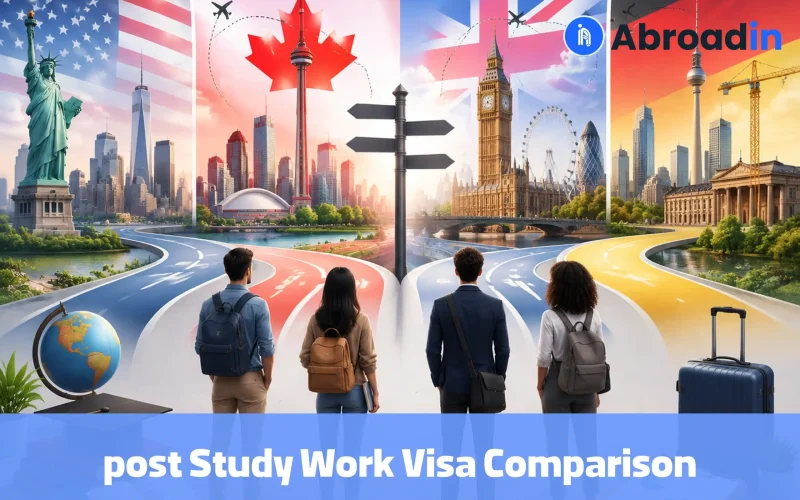
Choosing the best country for a post study work visa depends on your goals and profile. The USA is the best option for those who want cutting‑edge industry experience and can navigate more complex visa steps. Canada stands out for its clear bridge from study to work to permanent residence. The UK offers a simple Graduate visa that buys time to build UK experience. Germany has strong value for technical fields, with a solid path to skilled permits and long‑term residence. To match these options with your own background and plans, talk with experienced advisors from Abroadin and get up‑to‑date guidance.

Table of Contents

Responsive Banner
Post Study Work Visa Comparison: USA vs. Canada vs. UK vs. Germany
Choosing where to study abroad is not just about tuition fees or rankings; it is also about what happens after graduation. A post study work visa can give you valuable time to gain experience, build a network, and even move toward long-term residence. This Abroadin guide compares the USA, Canada, the UK, and Germany regarding post study work rules and limitations. Let’s get to them.
A post study work visa allows holders to stay in the country after graduation. International students may use this time to work, gain experience, and build professional networks.When graduates stay and work after their studies, they can apply what they learned to real projects. They understand local work culture, improve their language skills, and build a CV that stands out in global job markets.This type of visa also gives time to move from student life to professional life. Graduates do not need to rush back home right after exams. They can search for suitable roles, try internships, or switch jobs to find a better fit.For many, post study work visa is the first step toward a longer stay. Some systems reward local education and work experience with extra points or easier access to permanent residence.The length of stay is the first factor to compare post study work visas. A longer stay gives more time to search for skilled roles, pass probation periods, and meet salary or experience thresholds for next-step visas. Shorter visas can create pressure and limit the range of jobs graduates can realistically try.Eligibility rules are just as important. Some countries require study at specific institutions or in full-time programs. Others tie eligibility to the level of qualification, such as bachelor’s, master’s, or PhD.Students should confirm whether their chosen program, campus, and mode of study qualify them for a post study work visa before they apply for admission.In some countries, a post study work visa is an almost standard pathway to long-term status if the graduate finds a skilled job. In others, the post-study route is time-limited and does not guarantee a bridge to permanent residence.
Post-Study Work Options in the USA

The USA has several ways for international graduates to stay and work after graduation. Optional Practical Training (OPT) is the most common way for eligible F‑1 students to work in their field of study for a limited period.To qualify for OPT, students usually need to complete at least one full academic year in a Student and Exchange Visitor Program (SEVP)‑approved school. The program must lead to a degree or another eligible qualification.Students can use OPT at each higher education level. For example, they may use it once after a bachelor’s degree and again after a master’s degree.A Designated School Official (DSO) must recommend OPT in the student’s SEVIS record before the student files their application with immigration authorities.Not every course or institution leads to the same options. Language training programs and very short or part‑time studies may not qualify for OPT in the same way as full degree programs.Standard post‑completion OPT allows up to 12 months of full‑time work authorization after graduation. This period is tied to the specific degree level and major. The work must relate directly to the student’s main field of study.Graduates choose a start date within a set window after program completion, and once approved, they receive an employment authorization document (EAD) that shows the exact validity dates.STEM graduates may qualify for a major extension. If the degree is in an approved science, technology, engineering, or mathematics field, and if the employer meets certain requirements, the graduate can often extend OPT by an additional 24 months.It provides up to 36 months of post‑study work time. During the STEM extension, additional rules apply, including employer reporting requirements and the need for a formal training plan that links job tasks to learning goals.


Work Limitations and Job Types of the USA Visa
The most important OPT rule is that the job must be related to the field of study. A computer science graduate, for example, should work in a technology‑related role.Students often keep records, such as offer letters and job descriptions, to show that the work matches their major if authorities ever ask for proof.Graduates may work for multiple employers, switch jobs, or combine part‑time roles, as long as each position relates to their degree and they comply with the minimum hour requirements for maintaining status.They can usually work for startups, large companies, or even as self‑employed in some cases, if they can document real business activity and proper registration. However, unpaid roles or volunteer work must still follow labor rules and be used carefully.
Pathways Toward Long-Term Status in the USA
A common next step after OPT is the H‑1B specialty occupation visa. This route needs a sponsoring employer, a job that fits the “specialty occupation” definition, and a wage that meets set standards.For some graduates, other work visas may be a better fit. Examples can include:• company transfer routes if they join a multinational, or• specific categories for researchers and• highly skilled workers.These paths often demand higher qualifications, unique skills, or several years of experience. During their OPT or STEM period, many graduates focus on building profiles that match these standards.The long‑term goal for many is a green card, which grants permanent residence. Some routes go through employment‑based categories, where employers sponsor the process.Others depend on family ties or, in rare cases, special achievements. Progress from OPT to a green card can take many years and often involves several visa changes.
Post Study Work Visa for Canada
A Post‑Graduation Work Permit (PGWP) allows many international graduates to remain and work in Canada after completing their studies.The PGWP is an important bridge from student status to skilled Canadian work experience. It plays a major role in later applications for permanent residence through federal or provincial immigration programs.International students need to complete a program at a designated learning institution to qualify for post study work visa in Canada. The program must meet minimum length and level requirements.In most cases, it must be at least eight months long and lead to a degree, diploma, or certificate. Shorter courses or language training alone normally do not qualify for a PGWP.If a student switches schools or programs, they should confirm that the new institution is still a DLI and that the new program remains PGWP‑eligible.The length of a PGWP depends on the length of the completed Canadian program. Programs lasting at least 8 months but less than 2 years usually lead to a work permit that matches the program length.For programs of two years or more, graduates may qualify for a PGWP of up to three years. This longer period gives more time to gain Canadian work experience, qualify for skilled roles, and meet requirements for permanent residence.Some students choose two‑year diplomas or longer master’s programs with this in mind, even if a shorter course might meet their academic needs.
Work Flexibility and Job Types of Canadian Visa
The PGWP is an open work permit. It means graduates are not tied to a single employer or job. They can work full-time or part-time, or be self‑employed, in almost any field, as long as it meets general Canadian labor laws.Many permanent residence programs favor skilled work in specific National Occupational Classification (NOC) categories. Work in higher‑skilled roles often brings more points or meets mandatory criteria.Because of this, graduates often try to move into positions that qualify as skilled work as soon as they can. They may start in entry‑level jobs, then target promotions or new roles that match those classifications.The PGWP also allows graduates to gain Canadian experience across various settings. They can work for small firms, large corporations, or public institutions.Some use this time to test entrepreneurship and start their own business. The open nature of the permit allows adjustments if the first job is not ideal.Still, students must pay attention to conditions, such as medical requirements for certain occupations and any limits on work in specific sectors.
Pathways to Permanent Residence in Canada
Post‑study work in Canada closely aligns with permanent residence options. Canadian work experience gained under a PGWP can improve eligibility and competitiveness in several immigration programs.For many graduates, the most central system is Express Entry, which manages applications for certain federal economic programs.Within that system, the Canadian Experience Class often rewards recent skilled work in Canada, making it a popular route for former international students.Provincial Nominee Programs (PNPs) also play a major role. Each province and territory can run its own streams, some of which specifically target graduates of local institutions.These streams may require a job offer in the province, a certain length of work experience, or other conditions such as language levels.A nomination from a province usually adds a large number of points in the federal system, greatly increasing the chance of an invitation to apply for permanent residence.Graduates who plan to stay long term often choose cities and sectors where demand for their skills is strong.
Post-Study Work Options in the UK
The UK has a Graduate Visa, which lets eligible international students stay on and work after they finish an approved course.To qualify, a student must hold a valid Student visa at the time of application and must have completed a degree‑level or higher qualification, or another course that the rules accept for this route.It is important to choose a university or college that appears on the official list and has the correct status. During their studies, students must comply with visa conditions, including attendance, full‑time study (unless exceptions apply), and timely updates of contact details.Graduates apply from inside the UK, after they finish their course, but before their Student visa expires. They do not need a job offer to apply.The application process includes a fee and an immigration health charge, and they must provide identity documents and proof of current status.The length of permission under the Graduate visa depends on the level of qualification. Graduates of bachelor’s and taught or research master’s degrees usually receive up to two years of permission to stay.This period begins from the date the Graduate visa is granted, not from the date of course completion. It gives time to search for jobs, gain experience, and move between different roles and employers.PhD and other doctoral graduates generally receive a longer period, typically up to three years. The extra year can help them build a stronger profile, complete key projects, and secure sponsorship under a skilled work route later.
Work Limitations and Career Progression of the UK Visa
Graduate visa holders can work at any skill level and in most types of jobs, including full‑time, part‑time, self‑employment, and voluntary roles, as long as they respect general UK law.They are free to change employers without needing new permission, and they can move between sectors as their interests and opportunities evolve.However, there are still some limits. Certain roles, especially those involving professional training in regulated fields, may have extra requirements or may not be suitable under this route.Also, time spent on a Graduate visa does not normally count directly toward settlement in the same way as some skilled work visas do.It means while graduates can build a strong CV, they still need to plan for a later move into a category that leads to permanent residence.Graduates can start in entry‑level roles, internships, or temporary contracts while they prove their abilities. Over time, they can move into higher‑skilled positions that meet the criteria for long‑term work visas.Employers may feel more comfortable hiring candidates who already have valid work authorization, allowing graduates to demonstrate their value before requesting sponsorship later.
A Graduate Visa to Longer-Term UK Work Visas
The main goal for many graduates is to use the Graduate visa as a bridge to longer‑term work routes. One common next step is to move into a skilled worker‑type visa sponsored by an eligible employer.The job must be at an appropriate skill level and pay at or above a set salary threshold. The employer must hold the appropriate sponsorship license and issue a certificate of sponsorship for the role.Other routes may also fit, depending on the graduate’s profile. These can include visas aimed at global talent, certain high‑potential individuals, or specific sectors such as health and research.These categories often require strong academic records, recognized achievements, or offers from approved organizations. Time on the Graduate visa can help graduates build portfolios, publications, or project records that support these applications.
Post Study Work Visa for Germany
International students who complete a recognized degree at a German university can first enter a job‑seeking phase, then obtain a work permit once they find suitable employment.These options focus on skilled work and often connect to long‑term residence routes, especially for those in high‑demand fields such as engineering, IT, and applied sciences.Post‑study work options in Germany apply to non‑EU students who complete a recognized degree at a German higher education institution.Applicants must hold a valid residence permit for study purposes during their program. The degree should be from an officially recognized university or equivalent institution in Germany.Graduates must complete their course successfully and receive formal confirmation, such as a degree certificate or official letter from the university.This proof is important when they apply to extend or change their residence status. In most cases, they apply at the local foreigners’ office (Ausländerbehörde).The authorities check that the graduate studied in Germany and maintained legal status throughout the course, including health insurance coverage and timely renewal of the student permit.Not every program offers the same options. Preparatory courses, language courses alone, or very short stays may not qualify for the standard post‑study routes.
Job-Seeking Period and Work Rules of the German Visa
After graduation, many international students in Germany can extend their residence permit for a job‑seeking period. This period is usually 18 months or more.They can work in almost any job, not just roles directly related to their field, as long as they comply with general labor laws. They can focus on searching for positions, networking, and improving their CV. Many use this time to gain practical experience through temporary jobs, internships, or trainee programs, while they continue to look for a suitable skilled job that can support a longer‑term work permit.Once a graduate finds a qualified job that aligns with their academic background, they can apply to change their status from job‑seeker to an appropriate work residence permit.The job usually needs to meet certain standards, such as a suitable salary level and a clear match between duties and the graduate’s degree.
EU Blue Card or Other Long-Term Permits in Germany
A key goal for many graduates in Germany is to move from temporary post‑study status to a more stable work and residence permit.One important option is the EU Blue Card, which is designed for highly qualified professionals. The graduates need a recognized degree and an employment contract in Germany that meets minimum salary thresholds and falls into a skilled occupation.The salary requirement can be lower in shortage occupations, such as certain technical or medical fields.Graduates who do not meet the Blue Card conditions may still qualify for other work permits aimed at skilled workers.These permits also require a suitable job offer and proof that the person’s qualifications match the role.Depending on the route, there may be checks to see whether local or EU candidates are available, although recent reforms often ease this for certain sectors or degrees earned in Germany.Both the EU Blue Card and skilled worker permits can lead to permanent residence after several years, especially when combined with language proficiency and continuous employment.Time spent on certain permits counts towards the required residence period. Because of this, new graduates should view their first post‑study job as part of a longer path.
Conclusion
Choosing the best country for a post study work visa depends on your goals and profile. The USA is the best option for those who want cutting‑edge industry experience and can navigate more complex visa steps. Canada stands out for its clear bridge from study to work to permanent residence. The UK offers a simple Graduate visa that buys time to build UK experience. Germany has strong value for technical fields, with a solid path to skilled permits and long‑term residence. To match these options with your own background and plans, talk with experienced advisors from Abroadin and get up‑to‑date guidance.

Responsive Banner

How useful was this post?

Click on a star to rate it!

Average rating 0 / 5. Vote count: 0

No votes so far! Be the first to rate this post.

Releated Posts

universities with post-study work visa

Top Universities with Post-Study Work Visa

Having an excellent degree is only the first phase of an international education. Most international students aim to use that degree
cost to study abroad

The Real Cost to Study Abroad: Country-by-Country Breakdown

Managing expenses is one of the most critical aspects of planning to study abroad. Effective financial management is essential for a

No comment yet, add your voice below!


Add a Comment

Your email address will not be published. Required fields are marked *

Thousands of students have taken this path with us before you

Abroadin helps make the journey easier for you. You too can take your next step.

FAQ

What is Abroadin exactly, and how can I trust it?

Abroadin is a specialized online platform for academic immigration that helps students apply to universities abroad. It’s powered by a team of advisors who have personally experienced the study abroad journey. With over 100,000 users and a high satisfaction rate, Abroadin has earned a strong reputation for transparency, professionalism, and results.

How does Abroadin help me with academic immigration?

Abroadin supports you through the entire process — from choosing the right university and country, writing your documents (CV, SOP, etc.), contacting professors, and applying, to getting your visa and preparing for departure. Think of us as your one-stop academic immigration guide.

Why should I choose Abroadin over other immigration agencies?

Unlike traditional immigration agencies, Abroadin’s consultants have first-hand experience studying abroad. We offer transparent, affordable, and fully online services with a dedicated quality control team to ensure everything is done right. You’ll get advice that actually works — from people who’ve been in your shoes.

Does Abroadin charge for its services? What are the prices?

Some services are free (such as initial consultations and applying to partner universities), while others have a fixed fee. To see detailed information about packages and pricing, please visit:
👉 https://abroadin.com/ir/pricing

Which countries does Abroadin cover?

Abroadin helps students apply to a wide range of countries including Canada, the U.S., Germany, Italy, the Netherlands, Hungary, South Korea, Russia, China, and more. Each country has its own process, and our advisors will help you choose the best fit.

Can I apply through Abroadin without a language certificate?

Yes! In many cases, you can apply without a language certificate, or with a conditional admission that allows you to submit your test result later. Abroadin will guide you through universities and countries where this is possible.

Which stages of academic immigration can Abroadin help me with?

You can complete the entire journey with Abroadin — from writing your application documents (CV, SOP, LOR), contacting professors, applying to universities, securing admission, to preparing and submitting your visa application.

How can I know which Abroadin package is right for me?

Simple! You can book a consultation session where an advisor will assess your background, goals, and needs — then recommend the best package. To schedule a session, visit:
👉 https://abroadin.com/ir/consulting

Subscribe to our newsletter to get the latest updates

Free Application, Boundless Opportunities!

Apply to top universities worldwide without any application fees or initial costs – focus on your dreams, not the expenses.