
 Abroadin

Studying abroad is often an individual experience. However, many students, particularly at the graduate level, have spouses and children. The decision to bring their family along can make the experience rewarding for them, provided all necessary considerations are carefully addressed. Before taking any steps, it's essential to understand the related regulations and restrictions. For the latest information on study abroad with family visa in the 2026–27 academic year, read this post from Abroadin.
Why Study Abroad with Family?
International students need emotional support during their studies, so some bring their spouse and kids by them. This way, they can handle stress from being in a new environment better.
However, it's not just rewarding for students but also offers many opportunities for family members. For instance:
Their kids can:
- Experience cultural immersion.
- Learn new languages fast and
- Make friends from different backgrounds.
Spouses also benefit from employment perks in many countries:
- Australia has unrestricted work rights for dependents.
- Canada gives open work permits to spouses of master’s or PhD students.
- Germany allows family reunification.
There are some challenges too, including:
- Lining costs rise high.
- Families should pay more for housing and food.
- Schools in some places charge fees.
- Families require bigger apartments near universities.
Also, not all countries make it easy to bring dependents. The UK limits postgraduate students now. International students with families must have proof of funds, such as €11,000 per year.
If you are an international student considering having family beside you, weigh pros and cons. Decide if this path fits your resources and goals.

Study Abroad with Family Visa Application Guide
Applicants for family visas must avoid delays and rejections. They should start their process for study abroad with family visa early.
This Abroadin guide breaks the process down into five actions. Each step builds on the last. Follow these steps to succeed in your journey:
1. Assess Eligibility
Check whether your course complies with the country's rules first. For instance:
- The UK only allows postgraduate or government-sponsored students.
- Australia accepts most student visas.
- Canada limits to master's or PhD levels.
- Germany opens to all student visas.
- Sweden offers student residence permits.
- The US welcomes all F-1 levels.
Always review your program details. Look at the level and length. If you have young kids, check the school-age rules. Kids over six need school plans.
Contact your university's international office. They confirm eligibility fast. Use official government websites like gov.uk or migrationsverket.se.
Avoid agents who promise too much. This step saves time and money. You know your options clearly. Plan your top three countries. Pick one that best fits your family's needs.
2. Gather Documents for Study Abroad with Family Visa
Start by gathering all the necessary documents as early as possible. This step can take time, so it’s best not to leave it until the last minute.
The most important documents include:
- Valid passports for every family member,
- Marriage certificate if you are applying with your spouse, and
- Birth certificates to confirm your children’s relationship to you.
One key requirement is proof of financial stability. Many countries want to see that you can support yourself and your family without relying on public funds. For example:
- Germany currently requires around €11,280 per year for a single applicant, and you must show additional funds for each family member.
- In Australia, you may need to demonstrate an extra A$10,000 per dependent.
Bank statements are usually the most effective way to prove your financial situation. It's recommended to provide statements covering at least the past 6 months to demonstrate consistency and stability.
In addition to finances, health insurance is another essential requirement. Make sure your insurance plan meets all visa conditions and provides sufficient coverage for your stay.
You will also need to include your university acceptance letter if you are applying as a student. Some countries require a police clearance certificate to verify your background, and in certain cases, a tuberculosis (TB) test may also be necessary.
Make copies of all your documents and keep digital backups. It’s common for families to overlook children’s paperwork, so double-check everything against official checklists.
3. Student Visa First
Universities send acceptance letters after you pay the deposits. This paper starts with everything, so secure it first. Then, you must apply for a student visa.
Use official online portals. Fill forms accurately, and upload documents. Abroadin admission packages are great tools to help you through this process.
Processing a visa request takes 3-8 weeks. Track your application daily. Answer any embassy questions fast. When you get your visa approval, it consists of dependent options. Your family members must reference your number later.
4. Dependent Applications
Submit your spouse and kids' visas at the same time as yours. Use the same portal and link all applications to it.
Include accommodation plans. Show lease agreements or university housing offers. Provide space for the family. Add relationship proofs again.
Spouses apply for work permits where allowed. Rules in every country are different. Just for instance:
- Australia gives full-time rights.
- Canada offers open work permits.
- Germany limits to part-time.
The estimated budget for a family visa is €500-€1,000 per person. Processing matches your timeline. Submit everything together.
5. Study Abroad with Family Visa Post-Arrival
After arriving, your priority should be registering your residence. In Germany, this process (Anmeldung) must be completed within two weeks.
In Sweden, you’ll need to apply for a personal identity number (personnummer). Both are handled through local government offices and are essential for accessing services.
Next, arrange schooling or daycare for your children. Public schools in many countries accept children over the age of six free of charge.
In Germany, organizations like Studentenwerke often offer childcare options, such as crèches, but spaces can fill up quickly, so it's important to apply early. Health checks may also be required during enrollment.
Once these basics are covered, focus on settling into daily life:
- Open a local bank account,
- Get a SIM card, and
- Arrange any additional insurance.
Attend your university’s orientation sessions to understand available resources. At the same time, spouses can begin exploring job opportunities, while joining expat communities can help your family adjust more smoothly.
Keep track of visa requirements and plan extensions at least six months in advance. Stay organized with your children’s school records.

Practical Tips for Study Abroad with Family Visa
When deciding whether to study abroad with a family visa, you should carefully consider housing, schooling, childcare, and how your partner will adjust.
Many international students find that addressing these family needs upfront leads to smoother transitions and better academic performance.
Universities often provide family support services, including visa guidance and integration workshops, which can make the process easier.
Start by researching country-specific requirements early; things like family visa rules, healthcare access, and spousal work rights vary widely.
Create a timeline for key tasks, such as finding housing and enrolling children in school. Budget extra for initial setup costs, such as deposits and furniture. With the right preparation, studying abroad becomes a family adventure rather than a challenge.
Housing and Costs
Family housing is one of the biggest expenses when studying abroad with dependents, often costing 20–50% more than a single student dorm or studio.
Instead of a basic room, you’ll likely need a one- or two-bedroom apartment. It quickly adds up in popular student cities like Berlin, Munich, or Stockholm.
Fortunately, many universities and student unions offer family-friendly options, such as larger apartments or priority access to housing near campus.
These can be more affordable and convenient, sometimes including utilities like heating and internet, and even furniture.
For example, Germany’s Studentenwerke organizations manage student residences with family units in some locations, while Scandinavian universities often have cooperative housing schemes.
Always review what’s included in the rent. Check for bills, maintenance fees, or parking. Use platforms like university housing portals, WG-Gesucht, or local classifieds to compare options.
Childcare and Education
Childcare and schooling are crucial for families studying abroad, as they provide stability and routine for kids.
In Germany, Studentenwerke often assist international students with kindergarten or crèche placements at subsidized rates.
In many European countries, public schools are free for children starting around age five or six, allowing your school-age kids to join local systems without tuition fees.
However, navigating these systems takes effort. You’ll need to understand enrollment deadlines, language support programs (like immersion classes for non-native speakers), and catchment areas based on your address.
For younger children, daycare spots can be hard to come by. Join waiting lists immediately upon arrival and ask your university’s international office for guidance.
Health checks and vaccinations are typically required, so prepare documents in advance. Some countries, such as the Netherlands and Canada, offer excellent integration programs with English support.
Track academic records to ensure continuity if you return home. Many families find that local schools help children learn the language faster and make friends, easing the transition.
Spouse Integration
Your spouse's adjustment plays a huge role in your family's overall happiness abroad. When everyone feels included and purposeful, they settle faster.
Start by helping them explore job opportunities on local job boards (such as Indeed.de in Germany or Arbetsförmedlingen in Sweden), tailor their CVs to regional formats, and attend networking events.
Many universities extend career services to spouses, offering workshops on job hunting, interview skills, and industry insights.
Language courses are essential, especially outside English-speaking countries. Free or low-cost options, such as integration classes in Germany (Integrationskurs) or community centers, build confidence for daily interactions.
Encourage your partner to join expat groups, parent meetups, or hobby clubs via platforms like Meetup or Facebook.
Spousal work visas are increasingly common, so check rights early. When your spouse develops their own routine, communicates effectively, and pursues interests or part-time work, the family dynamic strengthens.
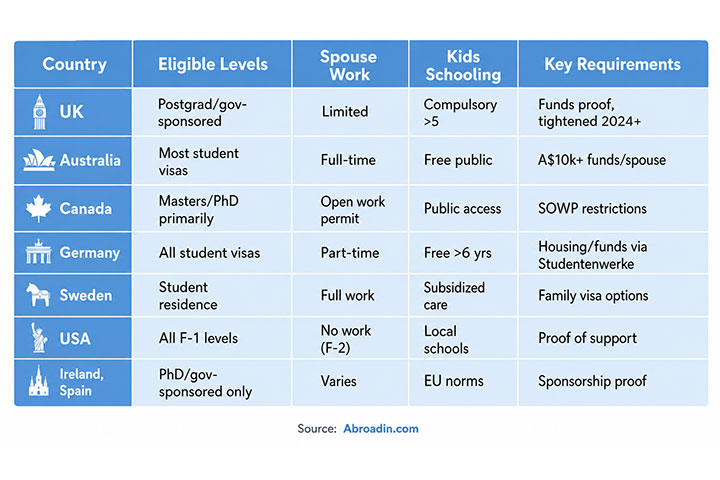
The following table compares family-friendly student visa policies across several popular study destinations:
Conclusion
Study abroad with family visa can be a life-changing decision. While challenges like costs and planning exist, the emotional support, cultural exposure, and career opportunities make it worthwhile for many families. With careful preparation and the right resources, this journey becomes easier. To explore more tips and guides, read other helpful blog posts on the Abroadin blog.
FAQs
1. Can I study abroad with my family on a student visa?
Many countries allow international students to bring their spouse and children through a study abroad with family visa program. However, rules vary by country and study level.
2. What documents are necessary for a family visa?
You need valid passports, marriage and birth certificates, proof of funds, health insurance, and your university acceptance letter. Some countries also require police clearance or medical tests.
3. How much does study abroad with family visa cost?
Costs increase when bringing family members. You must show additional funds for housing, living expenses, and dependents. Germany requires over €11,000 per year, plus an additional amount for each family member.
4. Can my spouse work while I study abroad?
In many countries, spouses can work under a study abroad with family visa. Australia offers full work rights, Canada provides open work permits, and Germany allows part-time jobs.
5. Are education and childcare available for children abroad?
Most countries offer schooling and childcare options to international students. Public schools are often free for school-age kids, while daycare may have limited availability.
Talk to an Abroadin advisor and get clarity on destinations, documents, funding possibilities, and your smartest next step.