

 Abroadin
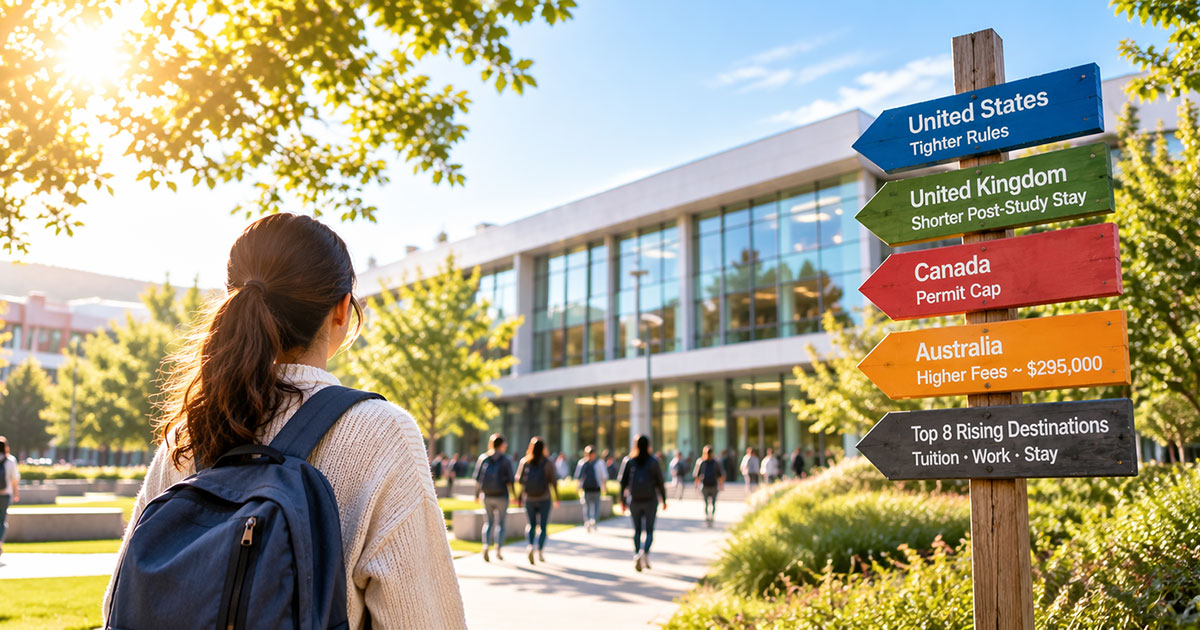
The best study destinations for 2027 look different from the list from five years ago. The US, the UK, Canada, and Australia have all tightened student rules at the same time. The UK shortened post-study stay, Canada capped permits, and Australia raised fees and set a level near 295,000. These changes have pushed students and families to reconsider where they can receive a quality education without facing high costs or uncertain immigration outcomes.
South Korea and Japan: Growing Study Destinations for 2027
Asia is leading growth in both student numbers and value. South Korea has already passed 300,000 international students, Japan exceeded 400,000 earlier than planned, and Malaysia is moving toward its 2030 target of 250,000.
All three countries are among the study destinations 2027 and expanding English-medium programs while linking work opportunities to language progress, academic performance, or immigration approval.
South Korea launched the Study Korea 300K Project in 2023, aiming to attract 300,000 international students by 2027. Enrolment reached 307,464 in 2026, almost two years ahead of schedule, with Vietnam as the leading source country. Seoul ranks among the world's leading student cities, and 158 universities are certified to offer international degrees.
Public universities charge USD 4,000 to 6,000 annually, while private institutions often charge USD 7,000 to 10,000. University accommodation starts near USD 250 per month, although private rentals in Seoul cost more. Students need a D-2 visa, proof of funds of USD 20,000 in Seoul or USD 15,000 elsewhere, and health insurance.
Japan has also expanded its international education ambitions, targeting 400,000 students by 2033. JASSO counted 408,069 international students in May 2025, while subsequent figures showed 435,200 students and 180,000 new arrivals. Three major Japanese universities have also received permission to increase international enrolment and adjust their fees.
National universities charge JPY 535,800 annually, plus a one-time admission fee of JPY 282,000. Private English-taught programs often cost JPY 1.3 million to 1.95 million in the first year. Average living expenses are around JPY 105,000 monthly, with Tokyo requiring USD 1,500 to 2,000 and smaller cities around USD 800 to 1,200.
Malaysia: Affordable Degrees and International Branch Campuses
Malaysia targets 250,000 international students by 2030, up from 130,000 to 170,000 currently, and aims to reach 500,000 by 2035. Private universities educate more than half of the country's international student population.
International branch campuses also provide access to British and Australian qualifications without requiring students to relocate to the universities' home countries.
Public university tuition ranges from USD 1,350 to 7,000 per year, while private institutions charge USD 2,300 to 9,500. Branch campuses are more expensive, but their fees remain around 30% to 50% below those of their home campuses.
Malaysia offers flexible part-time employment opportunities. International students can work up to 20 hours per week during academic terms with prior approval and full-time during scheduled breaks. These conditions make part-time work a useful source of supplementary income, although students should not depend on it to cover their essential expenses.
One of Malaysia's main advantages is its Graduate Pass. Graduates from 32 eligible countries can use this option to remain in the country, work, and travel for 12 months.
However, longer-term employment requires a suitable work pass, and later employment options are linked to higher salary thresholds. Consequently, students should consider their intended career and potential salary before selecting a degree.
France and Spain: Affordable Public Universities and
Study Destinations for 2027
France is moving toward 500,000 international students, Spain permits up to 30 hours of weekly work, and Ireland connects English-language degrees with major technology employers.
The UAE and New Zealand round out the list with contrasting advantages. The UAE offers international branch campuses and access to regional employment, while New Zealand provides generous post-study work rights.
France hosts 443,500 international students and is working toward its target of 500,000 by 2027. However, changes under Decree 2026-385 limit tuition-fee exemptions for non-EU students from the 2026–27 academic year.
Most new non-EU entrants pay EUR 2,895 annually for a bachelor's degree and EUR 3,941 for a master's degree, plus the EUR 105 CVEC contribution. Doctoral tuition remains near EUR 397, while grandes écoles charge higher fees.
Living expenses vary by location. Students in Paris should budget EUR 14,000 to 18,000 annually for housing, food, transport, and insurance. Lyon, Toulouse, and Lille are less expensive, with comparable costs of EUR 8,500 to 11,000. Authorities use around EUR 878 per month as the reference amount for visa financial assessments.
Spain offers another affordable European option. Public bachelor's degrees cost EUR 700 to 1,700 annually, while master's programs range from EUR 1,000 to 3,500. Private universities can charge up to EUR 20,000, and tuition in Madrid and Catalonia is higher than in Andalusia.
Non-EU students in Spain can work up to 30 hours per week during term after obtaining the required employer authorization. Graduates can apply for a 12-month job-search residence permit within 60 days after completing their studies, provided they meet the financial and health insurance requirements.
Once they receive a qualifying job offer, their employer can apply for the relevant work and residence authorization, which usually lasts one year.
Ireland: English-Taught Degrees and Access to Technology Careers
Ireland stands out because all its degree programs are taught in English and major technology employers operate near Dublin and Cork. This combination makes the country relevant to international students seeking English-language education and potential employment in the related professional fields.
The Irish public bachelor's programs for non-EU students cost EUR 9,850 to 27,000 per year. Taught master's degrees range from EUR 9,500 to 36,000, with technology and business programs occupying the higher end of the range.
Ireland's Stamp 2 permission allows international students to work up to 20 hours per week during academic terms. They can work up to 40 hours during the designated holiday periods: June to September and mid-December to mid-January.
No separate employment permit is required for work within these limits. However, students enrolled in Stamp 2A courses cannot work. The minimum wage stands at EUR 14 per hour from January 2026.
The country's Third Level Graduate Program provides a structured route for eligible graduates. Students completing Level 8 qualifications can receive 12 months on Stamp 1G, while Level 9 or higher graduates can qualify for up to 24 months. The application fee is EUR 300, and holders can work full-time while seeking graduate-level employment.
After Stamp 1G expires, graduates need a Critical Skills Employment Permit or General Employment Permit to remain employed in Ireland. Salary thresholds for these permits increased in 2026, making career planning an important part of the decision to study.
The UAE: International Branch Campuses in Study Destinations for 2027
The United Arab Emirates hosts more than 40 licensed universities in Dubai Academic City and Knowledge Park, alongside federal institutions elsewhere in the country. Its international branch campuses provide access to degrees associated with overseas universities, while its location offers exposure to regional business and employment markets.
Annual tuition at branch campuses ranges from AED 60,000 to 69,000, while federal university options charge AED 30,000 to 80,000. Living expenses also depend heavily on location. Students in Dubai should budget around AED 8,000 to 10,000 per month, whereas Sharjah offers a lower starting point of AED 3,800.
Universities sponsor a one-year renewable student residence visa through ICP or GDRFA. The application process involves medical examinations, biometric registration, and an Emirates ID, which students complete within weeks of arrival. Students aged 18 and above can work 15 to 20 hours per week with the required university certificate and labor authorization.
However, the UAE does not provide an automatic post-study stay or permanent residence simply because a student graduates. Jobseeker visas last 60 to 120 days for eligible graduates from top-500 universities or individuals with qualifying skill levels.
Outstanding graduates with a high GPA may apply for a 10-year Golden Visa within two years. Most other graduates need to secure an employment offer and switch to a two-year employer-sponsored residence visa.

New Zealand: Higher Tuition with Extended Post-Study Work Rights
New Zealand charges tuition fees comparable to traditional English-speaking study destinations but offers a straightforward post-study work pathway. A taught master's degree costs NZD 33,000 to 58,000 annually. A Bachelor of Arts at the University of Auckland costs NZD 40,225, while eligible PhD students pay around NZD 8,847 at domestic tuition rates.
International students must demonstrate that they can cover their full tuition fees and at least NZD 20,000 annually for living expenses. They must also account for airfare and insurance when preparing their financial documentation.
Students can work up to 25 hours per week during academic terms under the rules introduced in November 2025, and may work full-time during scheduled holidays. Research master's and PhD students can work unlimited hours while enrolled. The adult minimum wage is NZD 24 per hour from April 2026, making part-time employment a useful contribution toward living costs.
The main attraction is the country's Post Study Work Visa. Eligible master's and doctoral graduates can receive up to three years of open work rights, allowing them to work for any employer in any region without securing a job offer before applying. Master's and doctoral students must complete at least 30 weeks of full-time study in an eligible qualification to qualify for this route.
Bachelor's and Level 8 graduates receive a visa matching their actual study period, up to three years. A six-month Short-Term Graduate Visa is also available for certain Level 5 to 7 graduates who do not meet the Post Study Work Visa requirements.
Conclusion
The best study destinations 2027 reward students who link budget, language effort, and stay-back rules from day one. Korea, Japan, and Malaysia scale places fast at lower cost, while France, Spain, and Ireland hold fees down with defined graduate permits—the UAE and New Zealand trade higher tuition for tax-free pay or a three-year open visa. For tailored updates, deadlines, and university strategy, join the Abroadin newsletter below this article.
FAQs
1. How does South Korea link language level to work hours?
Bachelor students with TOPIK Level 3 or higher can work up to 30 hours on weekdays, with no cap on weekends, after immigration approval and adviser confirmation at certified universities.
2. What does a first year in Japan cost at a national university?
National universities charge 535800 yen per year plus a one-time admission fee of 282000 yen, while private English-taught programs often cost between 1300000 and 1950000 yen in the first year.
3. How does France limit work and stay after a master's?
Students can work up to 964 hours per year without a separate permit after the employer files a declaration, while master's graduates can apply for a 12-month APS job-search permit.
4. How does Spain handle work during study and after graduation?
Non-EU students can work up to 30 hours per week during term after employer authorization, while graduates can apply for a 12-month job-search residence within 60 days after completion, with proof of funds and health cover.
5. How long can New Zealand graduates work after study?
Master and doctoral graduates can receive three years of open work rights for any employer in any region after at least 30 weeks of full-time study in an eligible qualification, with no job offer required at the application stage.
Talk to an Abroadin advisor and get clarity on destinations, documents, funding possibilities, and your smartest next step.